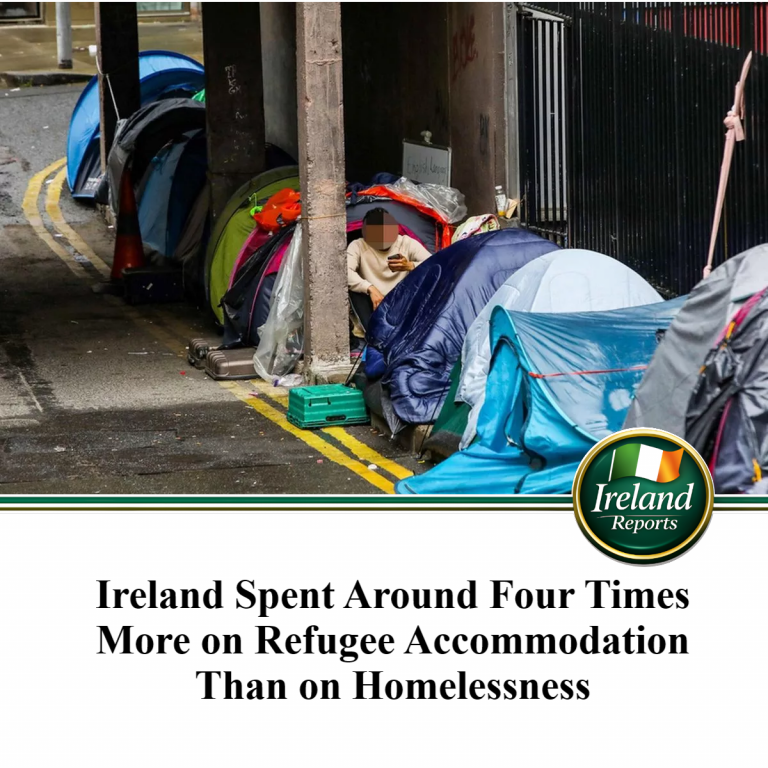
Ireland Spent Around Four Times More on Refugee Accommodation Than on Homelessness
2023 – 2025
Between 2023 and 2025, the Irish State spent approximately €4.5–5.1 billion on refugee accommodation, compared with around €1.0–1.1 billion on homelessness accommodation, once all relevant spending lines are fully aggregated and compared on a like-for-like basis. Based on official budgets, parliamentary answers, and published statistics, this means Ireland allocated roughly four times more housing-related funding to refugee accommodation than to homelessness over the past three years.
This comparison focuses strictly on accommodation costs. To avoid distortion, it excludes social welfare payments, healthcare, education, and integration supports on both sides. The aim is to compare what the State spent to house people, not the broader cost of supporting them.
Homelessness accommodation spending
Homelessness accommodation funding is administered primarily through local authorities under the Department of Housing. When core allocations and confirmed supplementary funding are combined, spending on homelessness accommodation amounted to approximately:
- €317 million in 2023
- €385 million in 2024
- €303 million in 2025 (provisional)
This places total homelessness accommodation spending over the three-year period at about €1.0–1.1 billion. These figures include emergency accommodation, hotels and B&Bs, family hubs, and homelessness-specific supports such as Housing First. General social housing budgets not explicitly linked to homelessness are excluded.
Despite rising expenditure, outcomes worsened. Official monthly data shows that the average number of people in emergency accommodation rose from roughly 13,000 in 2023 to over 15,000 by 2025. Children consistently accounted for more than a quarter of the homeless population. Hotels remained a central feature of the response, and long-term homelessness persisted.
Refugee accommodation spending
Spending on refugee accommodation is distributed across multiple departments and delivered primarily through International Protection Accommodation Services, accommodation for Ukrainian Temporary Protection beneficiaries, and private hosting supported by the Accommodation Recognition Payment.
Based on parliamentary answers and departmental statements, accommodation-related refugee spending is estimated at:
- €1.5–1.7 billion in 2023
- €1.8–2.0 billion in 2024
- €1.2–1.4 billion in 2025 (provisional)
This produces a three-year total of around €4.5–5.1 billion. These figures cover hotels, state centres, modular units, private hosting payments, and accommodation-linked operational costs. As with homelessness, welfare, education and healthcare costs are excluded to maintain comparability.
Capacity and outcomes
The divergence in outcomes is striking. Refugee accommodation was mobilised rapidly, with tens of thousands of people housed within months through emergency contracting, central coordination, and, where necessary, planning flexibility. Homelessness policy, by contrast, remained heavily reliant on emergency accommodation and delivered limited permanent exits over the same period.
This comparison does not argue against refugee protection. It documents state capacity and sequencing. The refugee response demonstrated that the State can mobilise billions of euro quickly, contract accommodation at scale, and act with urgency when required. Homelessness, a long-standing and predictable crisis, was not addressed with the same intensity.
What the data shows
Based on verified figures from budgets, parliamentary answers and official statistics, the conclusion is straightforward: Ireland spent around four times more on refugee accommodation than on homelessness accommodation between 2023 and 2025. Homelessness increased despite rising spend, while refugee accommodation scaled rapidly. The evidence indicates that this outcome reflects policy choices and prioritisation, rather than an absence of financial or administrative capacity.
This article is an extract from a longer, fully sourced investigation examining Irish government spending on homelessness and refugee accommodation between 2023 and 2025. The full investigation includes detailed methodology, year-by-year expenditure tables, counterfactual analysis, and direct links to all official sources. If you would like to read the full investigation and access the complete source list, you can do so here.