Ireland’s Expensive Habits: From a €2.24 Billion Children’s Hospital to a 2 Million Euro Printer
We recently published an investigation on this website into the new National Children’s Hospital in Dublin and the wider failures surrounding public spending and oversight in Ireland. That hospital, still unfinished, has already entered the record books as one of the most expensive buildings ever constructed anywhere in the world.
Unfortunately, the hospital is not an isolated failure. It is the most visible example of a pattern that has become increasingly difficult to ignore. Across the Irish state, relatively ordinary public projects have repeatedly spiralled into costs so extreme that they border on the surreal.
Several recent cases illustrate the scale of the problem.
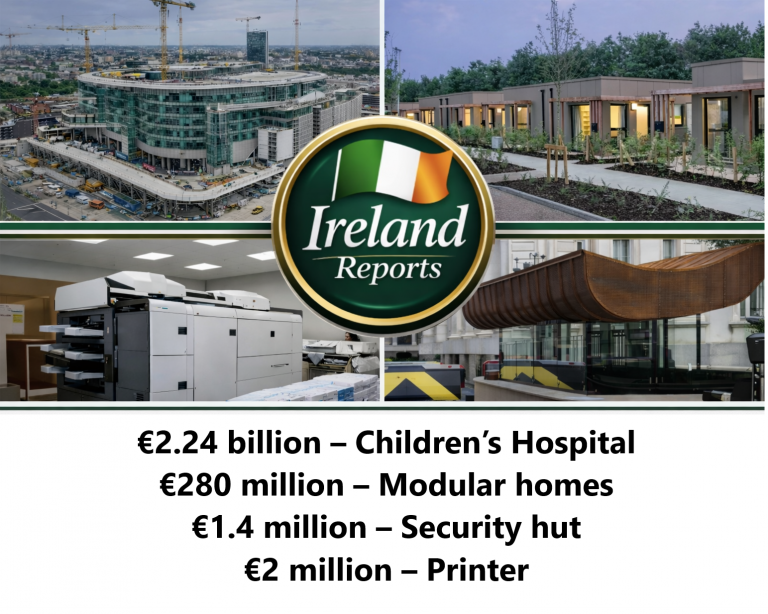
In December 2019, Leinster House, the seat of the Irish government, acquired a new printer. The machine measured approximately 2.1 metres high and 1.9 metres wide. Its initial declared cost was €800,000. It was soon discovered that the printer did not fit into the room designated to house it.
Reconstruction work was ordered to make space for the printer. That work cost an additional €200,000. It later emerged that the original price of the printer had been understated. When tax and associated elements were included, the true cost rose to €1.36 million. Renovation expenses also increased, eventually reaching €300,000.
During this period, the printer remained in storage. Storage fees came in just under €15,000.
By the time the issue was resolved, the total cost associated with this single printer exceeded €2 million.
The government at the time, led by Fine Gael under Leo Varadkar, distanced itself from responsibility. Varadkar stated publicly that the matter was one for the Ceann Comhairle and the Houses of the Oireachtas, adding that it was not the government’s business.
Spending did not stop there.
In 2024, Leinster House unveiled a new bicycle shelter. The structure, designed to hold around eighteen bicycles, cost the taxpayer €336,000. Responsibility for the project lay with the Office of Public Works, part of the portfolio of Minister of State Kieran O’Donnell.
Official figures showed that €322,000 was spent on construction and installation, with a further €13,000 allocated to archaeological services and contract administration. The Office of Public Works stated that the project presented unique challenges and that specific materials were required to ensure durability and compatibility with the historic parliamentary setting.
Months later, the Irish Independent reported that daily usage of the shelter rarely exceeded ten bicycles.
Public anger followed. A review was ordered, and officials from the Office of Public Works were summoned before a parliamentary committee to explain the cost. During that same hearing, another project emerged that made the bicycle shelter appear modest by comparison.
A security hut constructed at the Department of Finance had cost approximately €1.4 million.
The structure, described as roughly the size of a large mobile home, included €283,000 for the pavilion itself, more than €390,000 in building and site costs, €140,000 for ramps and turnstiles, and more than half a million euro for mechanical, electrical, and security systems. A copper roof alone cost €60,000. Temporary security measures added €90,000, while design fees exceeded €120,000.
More troubling still was the revelation that no minister had formally signed off on the project. The minister responsible for the Office of Public Works at the time stated that he was unaware of the expenditure until the Public Accounts Committee examined it.
The Irish Examiner later questioned what purpose a Minister for Public Works serves if the office is not accountable to parliament.
Following Russia’s invasion of Ukraine in February 2022, Ireland committed to accommodating more than 100,000 Ukrainian refugees. This pledge was made against the backdrop of an acute housing crisis. Ireland now has the worst record in the European Union for housing access among young people, and homelessness has reached its highest level in the state’s recorded history.
To meet its commitments, the government turned to modular housing. The plan, again overseen by the Office of Public Works, aimed to deliver approximately 500 units by February 2023. Initial estimates placed the cost at around €200,000 per unit.
The final figures told a very different story.
Costs rose to approximately €436,000 per unit. Total expenditure approached €280 million. The projected number of homes shifted repeatedly, from 500 to 700 and back down to around 640. Completion dates slipped from early 2023 to sometime in 2025.
Public opposition led to protests at several construction sites, causing further delays. Completed units intended for three locations were placed into storage, at an additional cost of roughly €600,000.
Taken individually, these stories might be dismissed as embarrassing mistakes. Viewed together, they reveal a consistent pattern of failed cost control and weak accountability.
If the Irish state struggles to manage spending on printers, bicycle shelters, security huts, and modular homes, the question naturally arises. How does it handle genuinely large infrastructure projects?
The answer stands unfinished in south Dublin.
Construction of the National Children’s Hospital began in 2016. It was originally scheduled to open in 2020. It has yet to treat a single patient. The approved budget now exceeds €2.24 billion, with the final cost still uncertain.
Official reviews have consistently found no evidence of corruption. Instead, they point to underestimation, mismanagement, and systemic incompetence.
That distinction matters. But so does scale.
A single security hut cost more than Ireland spent on military recruitment over two consecutive years. A printer cost more than many rural schools. A children’s hospital now costs as much as some of the most famous buildings on the planet.
Ireland is a wealthy country on paper. History shows, however, that financial complacency carries risks. The lessons of 2008 are still uncomfortably close.
The question is no longer whether Ireland can afford these failures.
It is whether it can afford to keep repeating them.
What ties all of these stories together is not just cost overruns. It is the near total absence of consequences.
In the private sector, even a fraction of this behaviour would be career ending. A manager who approved a two million euro printer that did not fit into its room would not be transferred sideways. They would be dismissed. An executive who signed off on a one point four million euro security hut without oversight would not be invited to explain themselves years later. They would be held personally accountable. In many organisations, approving repeated six figure overruns on basic infrastructure would be grounds for immediate termination.
Yet within the Irish state, these events are treated as unfortunate learning experiences. Reviews are commissioned. Committees are convened. Reports are published. Budgets are revised upward. Timelines are quietly extended. Responsibility dissolves into process.
The result is a system where spending decisions of extraordinary scale are normalised, while accountability remains optional. Contractors continue to bill. Departments continue to approve. Ministers continue to express surprise after the fact. The public is asked to accept that no one individual is ever truly responsible.
This is where the outrage lies. Not merely in the money spent, but in the precedent it sets. When a state demonstrates that it can lose control of hundreds of millions on modular housing, millions on minor buildings, and billions on a hospital without enforcing consequences, it signals to every contractor and every department that failure is survivable.
The National Children’s Hospital looms over this landscape as the ultimate example. A project so large, so delayed, and so expensive that it has become untouchable. Its scale now serves as a shield. No one can reasonably be fired for it, because too many people were involved. No one can be held singularly accountable, because responsibility was spread thin enough to disappear.
That is not just bad governance. It is dangerous governance.
A system that cannot say no to costs, cannot stop projects midstream, and cannot hold decision makers accountable is a system that invites repetition. If a two million euro printer, a three hundred thousand euro bike shelter, a one point four million euro hut, and a two point two four billion euro hospital can all occur without consequence, then the next failure is not a question of if. It is a question of scale.
Ireland does not lack money. It lacks restraint. And more critically, it lacks a culture of accountability equal to the sums it now routinely spends.