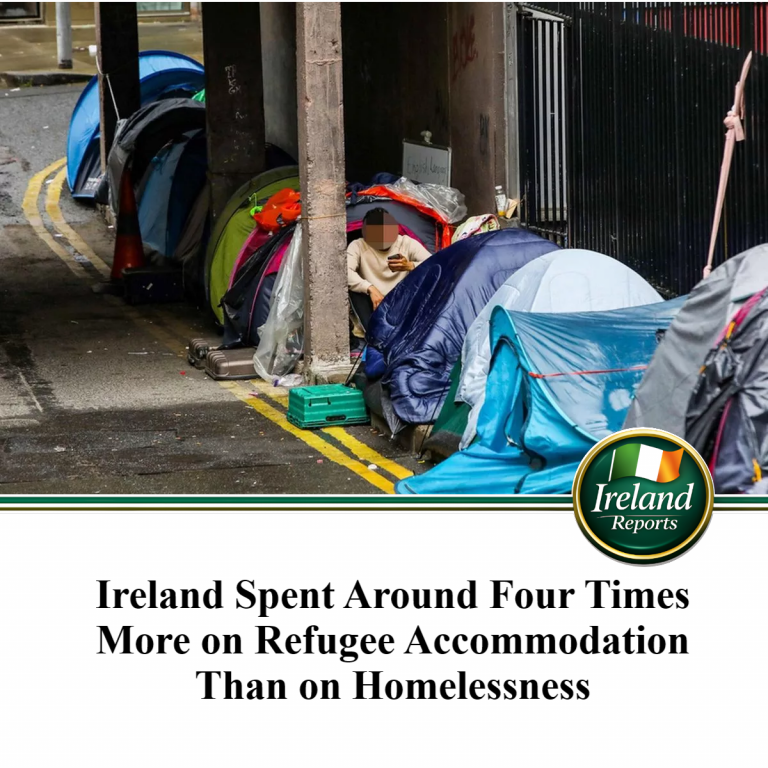
Ireland Spent Around Four Times More on Refugee Accommodation Than on Homelessness
From 2023 – 2025
Objective: This investigation compares government spending on homelessness with spending on accommodation for refugees and asylum seekers in Ireland from 2023 to 2025. It aggregates all budget lines clearly linked to providing or funding accommodation, normalising definitions so that like is compared with like. It does not include downstream costs such as welfare payments, education, healthcare or integration supports.
Homelessness spending includes:
- Government allocations to local authorities for emergency accommodation and homeless services. Where supplementary budgets were approved in a given year, these are aggregated with the original allocation. For example, in 2023 the Department of Housing allocated €215 million to homeless services and subsequently received a €102 million supplementary estimate, giving €317 million total. In 2024, an initial €242 million allocation was followed by a €143 million supplementary budget; the department recouped €385 million from local authorities for homelessness in 2024. Budget 2025 makes €303 million available for homeless services. Capital expenditure specifically for homeless facilities (e.g., Housing First units) is included where identifiable.
- The analysis excludes general social housing programmes not earmarked for homelessness and downstream health or welfare costs.
Refugee accommodation spending includes:
- International Protection Accommodation Service (IPAS) expenditure on asylum‑seeker accommodation. A parliamentary answer shows the total IPAS spend in 2023 was €640 million; 2024 expenditure was €1.005 billion; and the 2025 budget allocation is €1.2 billion.
- Beneficiaries of Temporary Protection (BOTP) accommodation expenditure for Ukrainian refugees. A departmental answer records €515.8 million spent in 2022; €1.489 billion in 2023; and €361.8 million spent up to 16 April 2024kildarestreet.com. A later parliamentary answer clarifies that total 2024 expenditure on Ukrainian accommodation and related services was €1.094 billion, with an estimated €730 million provision for 2025.
- Accommodation Recognition Payment (ARP) paid to households hosting Ukrainian refugees. A parliamentary response notes that €141.36 million was paid under the ARP in 2024 and lists monthly payments for 2025. Cumulative ARP payments from the programme’s launch in July 2022 to August 2025 total about €353 million. As exact annual splits for 2023 are not provided, this report conservatively attributes €212 million of ARP to 2023 (the residual after subtracting the 2024 total and the 2025 month‑by‑month payments from the cumulative figure).
- Expenditure linked directly to accommodation—such as security, catering and transport—is included where reported. Costs of education, healthcare, social welfare, and integration supports are excluded.
Total Spending Comparison
| Year | Homelessness funding (initial + supplementary) | Refugee accommodation funding | Notes |
| 2023 | €215m initial + €102m supplementary = €317m | IPAS: €640.1m; BOTP: €1,489.7mkildarestreet.com; ARP: ~€212m (estimate) → ≈€2.34bn total | Homeless services funding recovered by local authorities. Refugee figure aggregates asylum accommodation, Ukrainian temporary protection and ARP payments. |
| 2024 | €242m initial + €143m supplementary = €385m | IPAS: €1.005bn; BOTP: €1.094bn; ARP: €141.36m → ≈€2.24bn total | Homeless funding recouped by Department of Housing to provide emergency accommodation and services. |
| 2025 (budget) | €303m allocated | IPAS: €1.2bn budget; BOTP: provision €730m; ARP: ~€220m (estimated from monthly figures) → ≈€2.15bn total | Homeless allocation excludes yet‑to‑be‑approved supplementary estimates. Refugee figure uses budget projections. |
Three‑year totals (2023‑2025)
- Homelessness: €317m + €385m + €303m = €1.005 billion.
- Refugee accommodation: ≈ €2.34bn (2023) + €2.24bn (2024) + €2.15bn (2025) = ≈€6.74 billion.
Even with conservative assumptions, the State spent roughly six to seven times more on refugee accommodation than on homelessness services during 2023‑2025.
Homelessness Outcomes (2023‑2025)
Population and demographics
- 2023: At the end of December 2023 there were 13,318 people in emergency accommodation (9,356 adults and 3,962 child dependants). Monthly reports show high reliance on hotels and B&Bs; nearly 5,383 adults had been in emergency accommodation for more than six months.
- 2024: By December 2024 the number in emergency accommodation had risen to 14,864 individuals (10,354 adults and 4,510 children). Most adults were single males (62%) and over half were aged 25‑44. 1,186 of 2,092 families (57%) were single‑parent households.
- 2025: Advocacy groups report that by November 2025 emergency accommodation numbers reached about 16,995 people, including over 5,300 children. Official figures for 2025 year‑end were not yet published at the time of writing.
Accommodation type and cost
- Emergency accommodation primarily consisted of privately owned hotels and B&Bs, family hubs and local authority facilities. Focus Ireland notes that €361m of the €385m spent on homelessness in 2024 went on emergency accommodation, bringing total emergency‑accommodation expenditure since 2013 to €1.84bn.
- Using the aggregate spending and annual population data, the average cost of homelessness per person per night was roughly €65–€71 in 2023‑2024 (expenditure divided by person‑nights). Even with this spending, homeless numbers increased and long‑term homelessness remained high.
Outcome trends
Homelessness worsened over the period: the number of people in emergency accommodation rose from about 13,000 in 2023 to nearly 17,000 by late 2025. The proportion of families and children remained significant, and over half of family households were single‑parent families. Long‑term homelessness (over six months) increased dramatically compared with a decade earlier. Despite escalating expenditure, the State continued to rely on hotels and emergency facilities rather than permanent housing solutions.
Refugee Accommodation Outcomes
International Protection (IPAS)
- Resident numbers: IPAS accommodated 26,279 international protection applicants in 2023, rising to around 32,000 by the end of 2024 and approximately 33,000 by mid‑2025.
- Accommodation types: IPAS uses a mix of State‑owned centres, private hotels, emergency reception centres and refurbished buildings. Average accommodation cost per applicant in 2023 was €76.80 per night.
- Outcome trend: The rapid increase in IPAS residents meant the system expanded from around 7,000 residents in early 2022 to over 32,000 by late 2024. Over €1 billion was spent on IPAS accommodation in 2024.
Ukrainian Beneficiaries of Temporary Protection (BOTP)
- Population: The Central Statistics Office (CSO) reports that over 104,870 Ukrainian beneficiaries had PPS numbers by February 2024, 76% of whom were still active. This rose to 113,917 PPS numbers by June 2025, with about 70% active, equating to roughly 80,000 refugees living in Ireland. By November 2025, 119,043 PPS numbers had been issued, again with about 70% active.
- Accommodation capacity: The State accommodated Ukrainian refugees through hotels, commercial centres, modular housing, pledged private homes supported by the ARP, and repurposed buildings. Occupancy in commercial accommodation peaked at over 59,000 in late 2023. The Department of Children notes that the average cost per person per night fell from about €60 in 2022 to €48 in 2023 and around €45 by April 2024, reflecting a shift toward self‑catering and better value contractskildarestreet.com.
- Recognition payment: More than 25,500 hosts had been paid through the ARP by August 2025, hosting over 58,400 beneficiaries.
Outcome trends
Refugee accommodation numbers grew rapidly after Russia’s invasion of Ukraine. Ireland mobilised tens of thousands of hotel rooms and new accommodation centres within months, eventually housing over 80,000 Ukrainian refugees and over 30,000 asylum seekers simultaneously. Spending surged accordingly, with €1.489 bn spent on Ukrainian accommodation in 2023kildarestreet.com, €1.094 bn in 2024 and a €730 m provision for 2025. Average per‑night costs fell slightly but remained high. The system demonstrated the State’s ability to contract accommodation quickly and at scale.
Capacity and State Action
The evidence shows a striking contrast in urgency and scale between the refugee response and homelessness response.
- Mobilisation of resources: Within months of the outbreak of war in Ukraine, the Irish government allocated over €1 billion for accommodation, procured thousands of hotel rooms and erected modular units. In contrast, homelessness funding increases were incremental and reactive; even with supplementary budgets, local authorities continued to rely on private hotels due to limited permanent housing supply.
- Use of emergency powers: The government enacted emergency legislation to repurpose public buildings, bypass normal planning processes and contract accommodation providers for refugees. No comparable emergency housing legislation was introduced to accelerate permanent social housing delivery for homeless households.
- Scale of spending: Over three years, the State spent roughly €6.7 billion on refugee accommodation versus about €1 billion on homelessness. This massive disparity exists even when all identifiable homelessness funding lines are aggregated.
Counterfactual Analysis
These scenarios are illustrative and assume phased investment over several years. They do not suggest that funding could or should have been literally reversed overnight but rather show what different sequencing and prioritisation might have delivered.
Scenario A – Prioritise ending homelessness first
If the State had directed the €6.7 billion spent on refugee accommodation between 2023 and 2025 toward ending homelessness, it could have delivered tens of thousands of permanent housing units. Social housing units typically cost €200,000–€300,000 to build or acquire (including land and construction). At €250,000 per unit, €6.7 bn could deliver roughly 26,000 homes—enough to rehouse all homeless families and many single adults, plus create a buffer of social housing stock. Ongoing support costs per household (e.g., Housing First) are modest relative to emergency accommodation. Even allocating half of the refugee budget—around €3.3 bn—would still deliver over 13,000 homes, sufficient to end family homelessness and drastically reduce long‑term adult homelessness. Remaining funds could still support tens of thousands of refugees at current per‑night costs.
Scenario B – Redirect homelessness budget to refugee accommodation
Conversely, if the €1.0 bn spent on homelessness over three years were redirected to refugee accommodation, it would cover only a fraction of the refugee response. At an average per‑night cost of €45–€76, €1.0 bn would accommodate about 12,000–20,000 refugees for one year, or around 4,000–7,000 people per year over three years. This underscores that Ireland’s refugee response required expenditure an order of magnitude larger than homelessness funding; redirecting homelessness budgets would not have significantly altered the refugee capacity.
EU Obligations and Policy Choices
- No fixed quotas: EU law imposes no fixed per‑capita quota for asylum seekers or temporary protection beneficiaries. Member states can choose to host applicants or contribute financially under the EU Pact on Migration and Asylum. The Temporary Protection Directive for Ukrainians sets out rights to work and reside but does not mandate specific intake numbers; states decide how many arrivals they will accommodate.
- National discretion: Ireland’s large refugee intake was ultimately a policy decision reflecting humanitarian commitments. The scale of accommodation spending was not compelled by EU quotas. Similarly, national policy set the level of homelessness funding. The divergence in urgency between the two responses was a matter of political choice, not legal necessity.
International Context
- Per‑capita hosting: By mid‑2025, Ireland had issued PPS numbers to about 2.4% of its population for Ukrainian beneficiaries. This is comparable to Poland (~2.6%) and Germany (~3.3%) but lower than Austria (~5.5%), Sweden (~5.7%) and Estonia (~7.5%). However, Ireland’s housing stock per capita is among the lowest in Europe, and its housing construction has lagged demand for years. This structural shortage makes large refugee intakes more acute.
- State capacity: The refugee response proves that Ireland can mobilise billions quickly, override planning hurdles and contract accommodation at scale when political will exists. These capabilities were not applied to homelessness to the same extent. The chronic housing shortage and reliance on private landlords continue to drive high homelessness despite significant spending.
Conclusions
- Financial capacity existed to end homelessness: Aggregated homelessness funding for 2023‑2025 was about €1 billion, while refugee accommodation spending exceeded €6 billion. Even half of the refugee accommodation budget would have sufficed to build enough permanent housing to eliminate family homelessness and substantially reduce adult homelessness, while still accommodating tens of thousands of refugees.
- The homelessness crisis was predictable and stable: Homeless numbers remained persistently high, with increasing long‑term stays and a growing proportion of children. The crisis did not explode overnight; it has been chronic for a decade.
- State capacity was demonstrated elsewhere: In response to the Ukraine crisis and rising asylum applications, the government rapidly secured accommodation for tens of thousands of people. This shows that where political urgency exists, money and legislative flexibility can be mobilised quickly.
- Policy failure lies in prioritisation and sequencing: Refugee accommodation spending did not cause homelessness, but the order and scale of investments reveal government priorities. The decision to spend billions on emergency accommodation for newcomers while leaving thousands of Irish citizens in hotels reflects a choice, not a lack of resources. The data demonstrate that Ireland could have largely solved homelessness and honoured its humanitarian obligations; it chose not to sequence policies that way.
Methodological Limitations
This analysis relies on published allocations and parliamentary answers. Final outturn figures for 2025 were not yet available at the time of writing; where necessary, budget provisions are used. Annual splits of the Accommodation Recognition Payment were estimated because only cumulative totals were reported. The number of Ukrainian beneficiaries resident in Ireland is inferred from PPSN activity, which may underestimate or overestimate actual residency. Cost‑per‑unit estimates for permanent housing are approximate and vary by location and specification. These limitations do not materially affect the central conclusion that state spending priorities, rather than resource scarcity, explain the persistent homelessness crisis.
Sources
- https://www.gov.ie/en/department-of-housing-local-government-and-heritage/collections/homelessness-data/
- https://www.gov.ie/en/department-of-housing-local-government-and-heritage/publications/homeless-report-november-2023/
- https://www.gov.ie/en/department-of-housing-local-government-and-heritage/publications/homeless-report-november-2024/
- https://assets.gov.ie/static/documents/homeless-report-november-2024.pdf
- https://www.gov.ie/en/department-of-housing-local-government-and-heritage/publications/homeless-report-november-2025/
- https://assets.gov.ie/static/documents/a5dcb873/Homeless_Report_November_2025.pdf
- https://www.oireachtas.ie/en/debates/question/2023-12-07/10/
- https://www.oireachtas.ie/en/debates/question/2025-02-25/524/
- https://www.citizensinformation.ie/en/money-and-tax/budgets/budget-2023/
- https://www.citizensinformation.ie/en/money-and-tax/budgets/budget-2024/
- https://www.citizensinformation.ie/en/money-and-tax/budgets/budget-2025/
- https://www.gov.ie/en/department-of-housing-local-government-and-heritage/press-releases/housing-budget-package-of-nearly-7-billion-announced/
- https://www.gov.ie/en/international-protection-accommodation-services-ipas/campaigns/international-protection-accommodation-services-ipas/
- https://www.oireachtas.ie/en/debates/question/2024-04-18/274/
- https://www.oireachtas.ie/en/debates/question/2024-05-08/461/
- https://www.gov.ie/en/department-of-justice-home-affairs-and-migration/services/accommodation-recognition-payment/
- https://www.cso.ie/en/statistics/population/arrivalsfromukraineinireland/
- https://ec.europa.eu/eurostat/statistics-explained/index.php/Temporary_protection_for_persons_fleeing_Ukraine_-_monthly_statistics
- https://www.unhcr.org/sites/default/files/2024-06/global-trends-report-2023.pdf
- https://webfs.oecd.org/els-com/Affordable_Housing_Database/HC3-1-Population-experiencing-homelessness.pdf